
EPISODIO · CONSTELACIÓN
The double work. Where does each alchemist look at the work from?
Este episodio está escrito en inglés, el idioma de la narración. Las citas enlazan a las fichas del corpus en español.
The map has two trunks, because the sources answer two different questions.
101 citas verificadas · 25 fuentes · 24 imágenes
El mapa de este episodio
La obra dobleHow it is usually told
You have probably heard one of two stories about alchemy.
In the first story, alchemy was a failed chemistry: people blowing at the coals under a crucible, hoping for gold. The French had a name for them, the puffers, "a term applied pejoratively to overly hopeful chymists in reference to their constant blowing (souffler) at the coals under their crucibles" «Principe — The Secrets of Alchemy (2013) · p. 205».
In the second story, alchemy was never about metals at all. Carl Gustav Jung claimed that alchemy "does not deal at all, or for the most part at least, with chemical experiments, but probably with something like psychic processes expressed in pseudochemical language" «Principe — The Secrets of Alchemy (2013) · p. 121». That story has a birth date. In the nineteenth century Mary Anne Atwood put it bluntly: "Man is the true laboratory of the Hermetic Art; his life the subject, the grand distillatory, the thing distilling and the thing distilled" «Principe — The Secrets of Alchemy (2013) · p. 113».
Each story answers a question the sources answer differently. And each story reads the recipes as if a recipe told you where its author stood. It does not.
The question
The map has two trunks, because the sources answer two different questions.
The first question is where the author looks at the work from. Not what the work does, which every treatise describes at length, but what the author says the work is, when he speaks about it rather than from inside it: is the primary thing the inner process, with the metal as its sign or its language; is it the work on matter, mineral, vegetable or animal, with everything else as language; or are the two one thing seen from two sides? A recipe never answers this. Only a sentence about the work does, and some authors never write one.
The second question is where the art comes from. Is it revealed from above, handed down from master to master along a lineage of sages, read directly in Nature, or does it arise in the operator himself? A voice can answer both questions, and most do. That is why the same book can appear twice on the map.
The answers on the map
Three positions on the first question, each one an answer that at least one source declares in its own words, and a fourth state that is not an answer but a fact.
From the soul. The primary thing is the inner process; the material work is its sign, its companion or its language. Declared by the Aurora consurgens, the Fama Fraternitatis, Thomas Vaughan, Jacob Boehme, Mary Anne Atwood and Carl Gustav Jung.
From matter. The primary thing is the work on matter, mineral, vegetable or animal; the rest is language or consequence. Declared by the Turba, Pseudo-Geber, Petrus Bonus, the Clavicula, Paracelsus, the Splendor Solis, the Rosarium, the Atalanta fugiens, the Golden Tract, the Rosicrucian Secrets, Eirenaeus Philalethes, Robert Boyle, Isaac Newton and the Breviary attributed to Flamel.
From both, as one. The work is material and spiritual at once, one thing seen from two sides, said as a principle. Declared by Zosimos, Heinrich Khunrath, and by us, Spiritus Mundi, with the passages of El Umbral de la Consciencia.
Not declared. The author speaks from inside the work, in recipes, matters and operations, and never says where he looks at it from. On this map that is the case of George Starkey's laboratory notebooks. It is a fact about the genre, not a gap.
Four answers to the second question.
Revealed. The art comes down from above: an angel, the Most High, a gift of God. Declared by eighteen of the twenty-four voices, from Zosimos to Boehme, and by us.
Handed down by a lineage. The assembly and the chain of the sages: the art is inherited from master to master. Declared by Petrus Bonus, the Turba, the Breviary, the Rosarium, the Splendor Solis, the Golden Tract, Khunrath, Starkey, Boyle, Newton, Atwood, and by us.
Read in Nature. Nature is the guide and the art follows her step by step. Declared by the Aurora consurgens, the Breviary, the Rosarium, the Splendor Solis, the Golden Tract, Paracelsus, Khunrath, the Atalanta fugiens, the Rosicrucian Secrets, Philalethes, Newton, and by us.
Arising in the operator. The root of the art is in what the investigator projects onto matter, not in a received doctrine. Declared by Jung alone, and it forced this branch open.
The voices
Zosimos of Panopolis (Egypt, around the year 300). The earliest alchemist we can name looks at the work from both sides at once, and says so as a condition, not as a mood. His alchemy "can only work if two conditions are met: the technical requirements must be perfect and perfectly understood and the alchemist must have gone through a process of mental preparation or purification to gain knowledge of his real self and his ultimate origin" «Hanegraaff (ed.) — Dictionary of Gnosis & Western Esotericism · p. 609». He "recommends practicing alchemy in both a corporeal and spiritual manner, and prescribes spiritual exercises for cultivating virtue through the purification of the soul, and for facilitating the soul’s ascent to the divine realms" «Grimes — Zosimus of Panopolis (tesis, 2006) · p. 62». On where the art comes from, he "claims that the art was initially revealed by an angel in a book titled Chémeu" «Principe — The Secrets of Alchemy (2013) · p. 33».
Turba Philosophorum (Latin, from an Arabic original, around 900). The assembly of the sages defines its art from matter, and says what the multiplicity of symbols is: names. "The envious have laid waste the whole Art with the multiplicity of names, but the entire work must be the Art of the Coin" «Turba Philosophorum, trad. inglés 1896 · p. 172». The soul it separates is the soul of the metal: "I testify that the definition of this Art is the liquefaction of the body and the separation of the soul from the body, seeing that copper, like a man, has a soul and a body" «Turba Philosophorum, trad. inglés 1896 · p. 205». It hands the art down a chain of nations, "derived from the philosophers of the Indies and from the Babylonians" «Turba Philosophorum, trad. inglés 1896 · p. 26», and reserves its arrival to "the will of God" «Turba Philosophorum, trad. inglés 1896 · p. 30».
Pseudo-Geber, Summa perfectionis (Latin, late thirteenth century). The Summa defines the end of the art by what is induced in matter: "If anyone should be able to induce these qualities in a given parcel of matter, then let him call that matter 'gold'" «Newman — Promethean Ambitions (2004) · pp. 294, 296». It even declares what it will not attempt: "our intention is not to follow nature in her principles, nor in the proportion of miscible elements, nor in the manner of their mutual mixture, nor in the equalizing of the thickening heat, for all these things are impossible and unknown to us" «Newman — Promethean Ambitions (2004) · p. 90». And the art is "a donum dei (gift of God), which the Father of lights will dispense only to His faithful, the “sons of doctrine.”" «Newman — Promethean Ambitions (2004) · p. 100».
Aurora consurgens (Latin, thirteenth or fourteenth century, attributed to Thomas Aquinas). The one voice of the Middle Ages that looks at the work from the soul, and says what the science is: "a gift and sacrament of God and a divine matter, which deeply and in divers manners was veiled in images by the wise" «Aurora consurgens, ed. latín e inglés 1966 · p. 65». The images are the veil; the inner condition comes first: "Scito, quod hanc scientiam habere non poteris, nisi mentem tuam Deo purifices" «Aurora consurgens, ed. latín e inglés 1966 · p. 128». All wisdom, it says, "a Domino Deo est, sed hoc quocumque modo dicitur semper a Spiritu Sancto est" «Aurora consurgens, ed. latín e inglés 1966 · p. 66», and no man can fulfil this science "without nature—the nature, that is to say, which is bestowed upon things and infused into them from heaven" «Aurora consurgens, ed. latín e inglés 1966 · p. 133».
Petrus Bonus of Ferrara (1330, according to William Newman). Petrus Bonus does the most declarative thing a scholastic can do: he says which science alchemy belongs to. Alchemy "works with the intrinsic principle of change in matter, while an architect, for example, does not lead an internal form to perfection, since his building materials have no inherent tendency to become a house" «Newman — Promethean Ambitions (2004) · p. 101». What the art does, nature cannot: "It is impossible for nature to follow art in the generation of the alchemist’s stone" «Newman — Promethean Ambitions (2004) · p. 103». He makes the chain a line of prophets, arguing "that the ancient alchemists were themselves prophets, and by an extension of this logic, he suggests that Adam, Moses, David, Solomon, and John the Evangelist were all alchemists" «Newman — Promethean Ambitions (2004) · p. 100», and he expands "the old image of alchemy as a donum dei—a gift of God" «Newman — Promethean Ambitions (2004) · p. 105».
The Clavicula (fourteenth century, attributed to Ramon Llull). Almost all recipe, the Clavicula steps out of the recipe twice. It grounds its truth in eye and hand: "We have shown that everything this treatise contains is true, because we have seen with our own eyes, we have operated ourselves and we have touched with our own hands" (our translation of «Hemos demostrado que todo lo que encierra este tratado es verdadero, porque hemos visto con nuestros propios ojos, hemos operado nosotros mismos y hemos tocado con nuestras propias manos» «La Clavícula (pseudo-Llull), trad. castellano · p. 7»). And it receives the art from above: "with the help and permission of the Most High, who was pleased to reveal the Great Work to me" (our translation of «con la ayuda y permiso del Muy Alto, al que plugo revelarme La Gran Obra» «La Clavícula (pseudo-Llull), trad. castellano · p. 1»).
Paracelsus (Switzerland, 1493 to 1541). Paracelsus says what alchemy is and what it is for: "Learn then Alchemy, also called Spagyria, and she will teach you to tell the false from the true" (our translation of «Aprended pues la Alquimia, también llamada Spagiria, y ella os enseñará a discernir lo falso de lo verdadero» «Paracelso — Obras completas, trad. castellano · p. 102»). He keeps the work apart from faith: "The medicine of the body is visible without any faith" (our translation of «La medicina del cuerpo es visible sin ninguna fe» «Paracelso — Obras completas, trad. castellano · p. 94»). Asked where the art comes from, he answers with the glassmaker, for whom it was enough to put the matter in the fire "for the light of nature to make the crystal appear before his eyes" (our translation of «para que la luz de la naturaleza haga aparecer el cristal ante sus ojos» «Paracelso — Obras completas, trad. castellano · p. 92»); and the physician's art and its principle "emanate from God" (our translation of «emanan de Dios» «Paracelso — Obras completas, trad. castellano · p. 80»). A lineage he declares impossible: if the physicians of other times rose from their tombs, "their art would be blind and void" (our translation of «su arte sería ciego y nulo» «Paracelso — Obras completas, trad. castellano · p. 79»).
Splendor Solis (German, 1532). The treatise says what the art is for before any recipe: "For unaided Nature does not produce things whereby imperfect metals can in a moment be made perfect, but by the secrets of Our Art this can be done" «Splendor Solis, trad. inglés 1920 · p. 15». And it leaves the human soul out of the field where the work operates: "For the form of every thing be it living, growing, or metallic, comes into existence by virtue of the interior force in matter—except the human soul" «Splendor Solis, trad. inglés 1920 · p. 15». Its foundation is Nature, for the art "originates in Nature, thence follows a natural end in a just form, through just and natural means" «Splendor Solis, trad. inglés 1920 · p. 13»; it closes calling the noble alchemy a thing that "is to be esteemed as the gift of God" «Splendor Solis, trad. inglés 1920 · p. 99»; and whoever proceeds properly "shall according to all Philosophers, begin where nature has left off" «Splendor Solis, trad. inglés 1920 · p. 21».
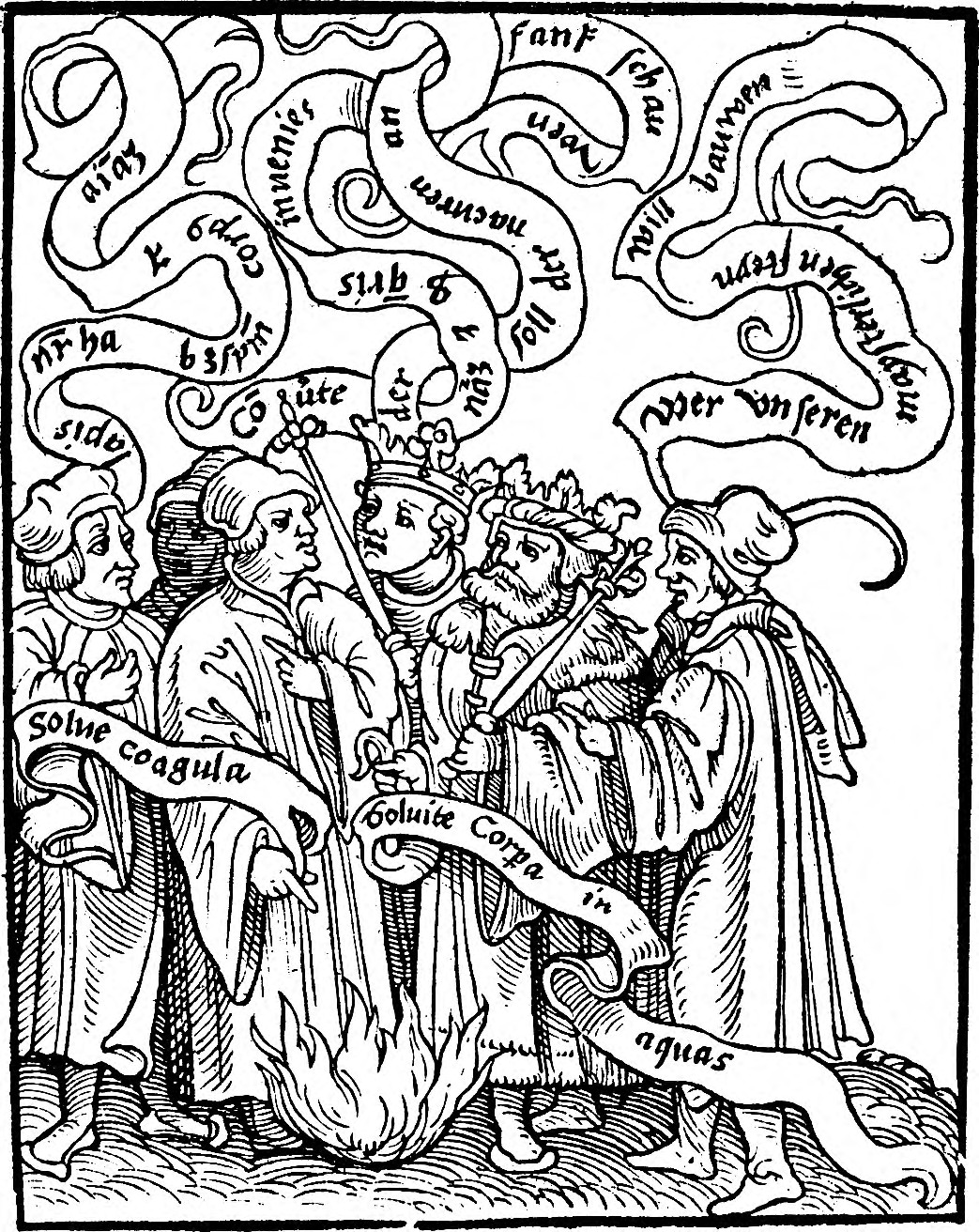
Rosarium Philosophorum (Latin compilation, printed 1550). The Rosarium defines the art in its own voice: "alchemy is the science of the transmutation of things from their forms and species" (our translation of «la alkimia es la ciencia de la transmutación de las cosa a partir de sus formas y especies» «Rosarium Philosophorum, trad. castellano · p. 34»), and under oath, "the art is nothing more than always dissolving and coagulating the stone" (our translation of «el arte no es nada más que disolver y coagular siempre la piedra» «Rosarium Philosophorum, trad. castellano · p. 28»). The art "is a gift of the Holy Spirit" (our translation of «es un don del Espíritu Santo» «Rosarium Philosophorum, trad. castellano · p. 6»), it names its recent master, Arnald of Villanova «Rosarium Philosophorum, trad. castellano · p. 6», and "our magistery is the work of nature and not of the artist" (our translation of «nuestro magisterio es la obra de la naturaleza y no del artista» «Rosarium Philosophorum, trad. castellano · p. 12»).
Heinrich Khunrath (Leipzig, 1595, according to Karpenko, Purš and Žemla). Khunrath looks from both sides, and his editors say so against the one-sided readings: he "is convinced that success in the transformation of metals depends on the inner transformation of the operating alchemist, but the reverse is also true: the production of the philosophers’ stone opens the way to the knowledge of God or directly to the ascent to him" «Karpenko, Purš y Žemla — Khunrath in Context (Brill, 2025) · p. 24». He "cannot be regarded as a “spiritual alchemist” for whom alchemy was nothing but allegory" «Karpenko, Purš y Žemla — Khunrath in Context (Brill, 2025) · p. 27». The essence of the Work comes "through what he calls an “enthusiastic Kabbalah,” a special kind of divine inspiration, secret visions and spiritual revelations" «Karpenko, Purš y Žemla — Khunrath in Context (Brill, 2025) · p. 69», or, if God wills it, "by a human teacher or enlightenment can come from the light of nature" «Karpenko, Purš y Žemla — Khunrath in Context (Brill, 2025) · p. 69».
Fama Fraternitatis (Cassel, 1614). The first Rosicrucian manifesto testifies in public where gold stands in the work: "the true philosophers are far of another mind, esteeming little the making of gold, which is but a parergon" «Yates — The Rosicrucian Enlightenment (1972) · p. 328». A parergon is a side work. Its founder, who could have bragged of transmutations, "did he esteem more Heaven, and the citizens thereof, Man, than all vain glory and pomp" «Yates — The Rosicrucian Enlightenment (1972) · p. 318». On where the art comes from, the Fama says nothing we can place with a passage of its own.
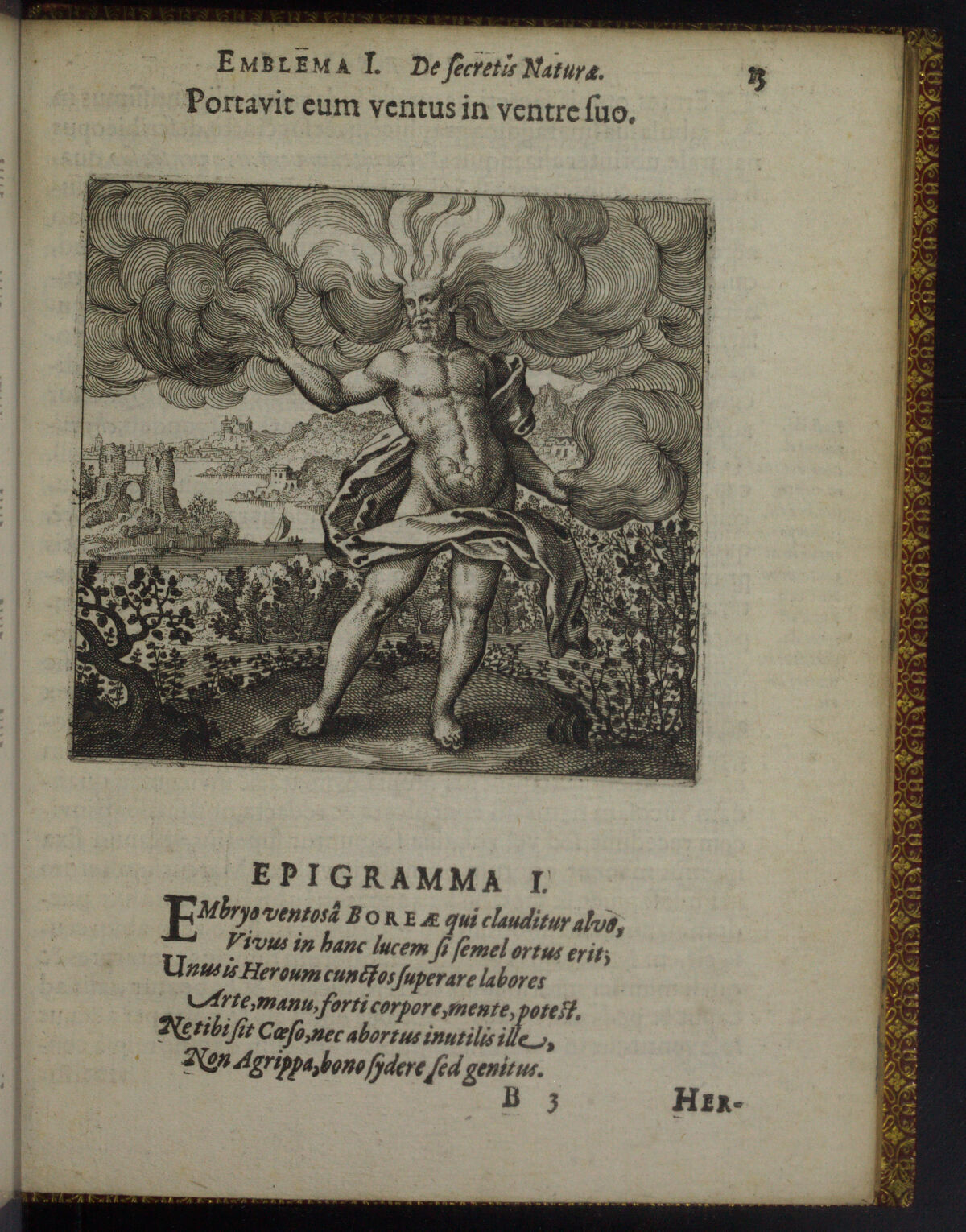
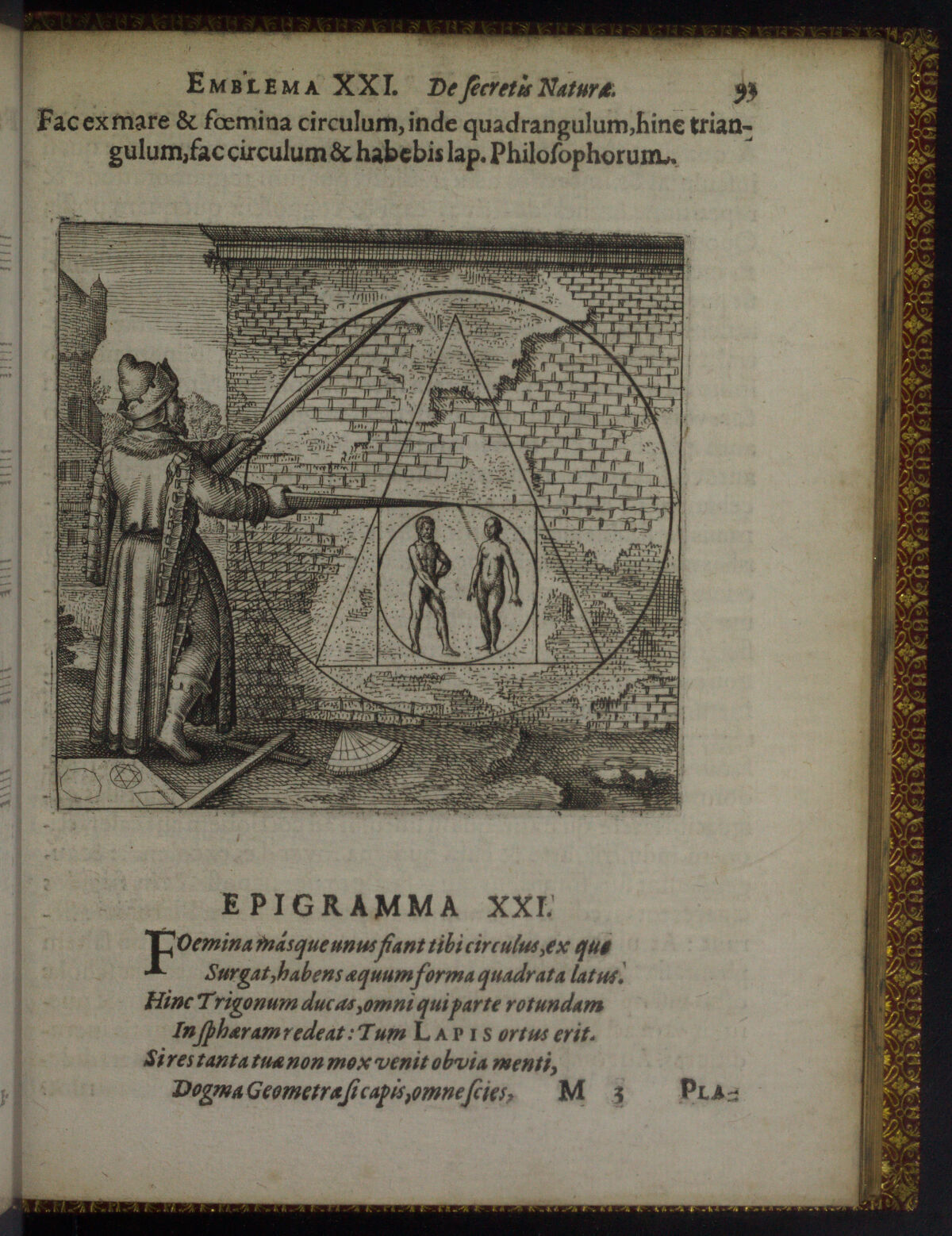
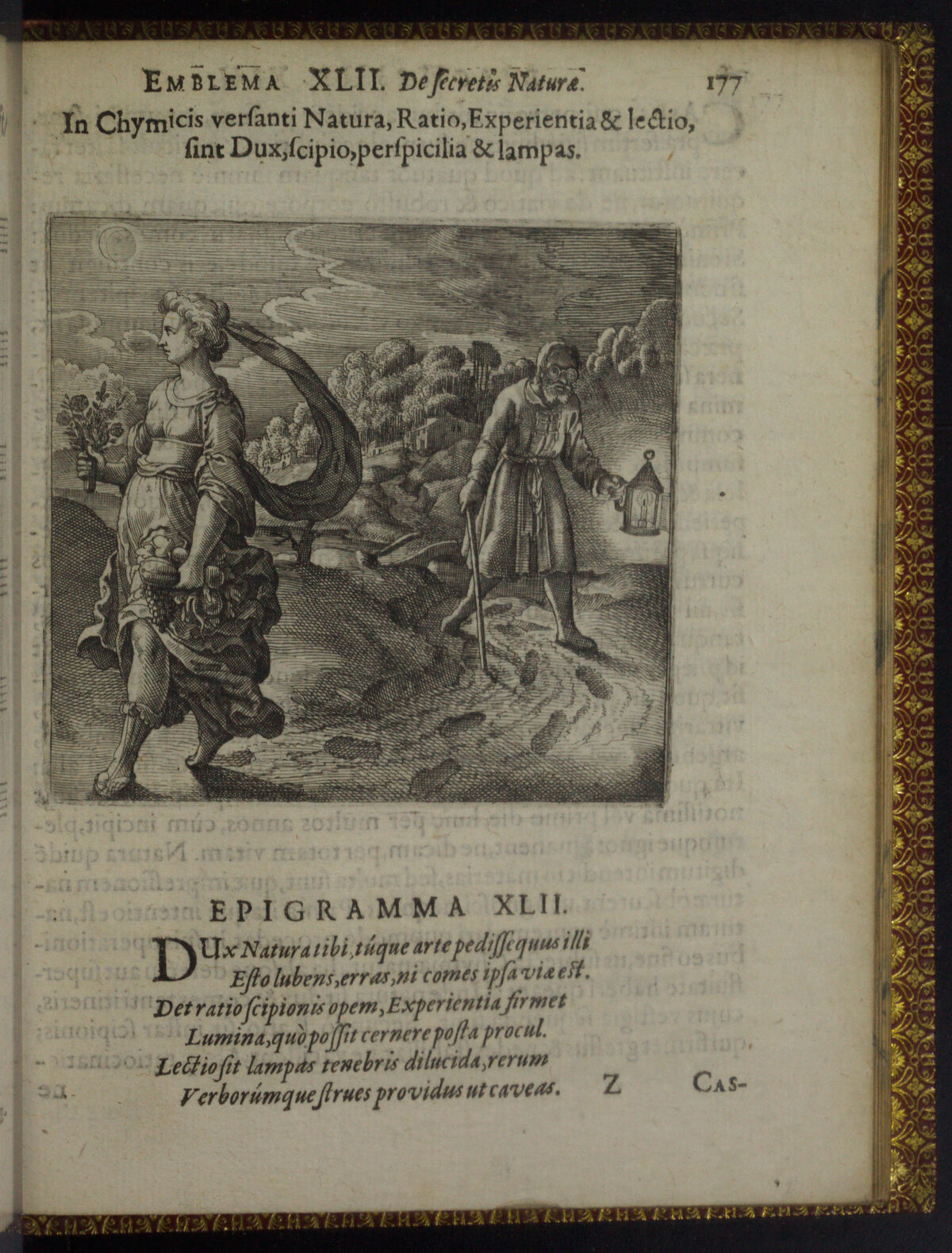
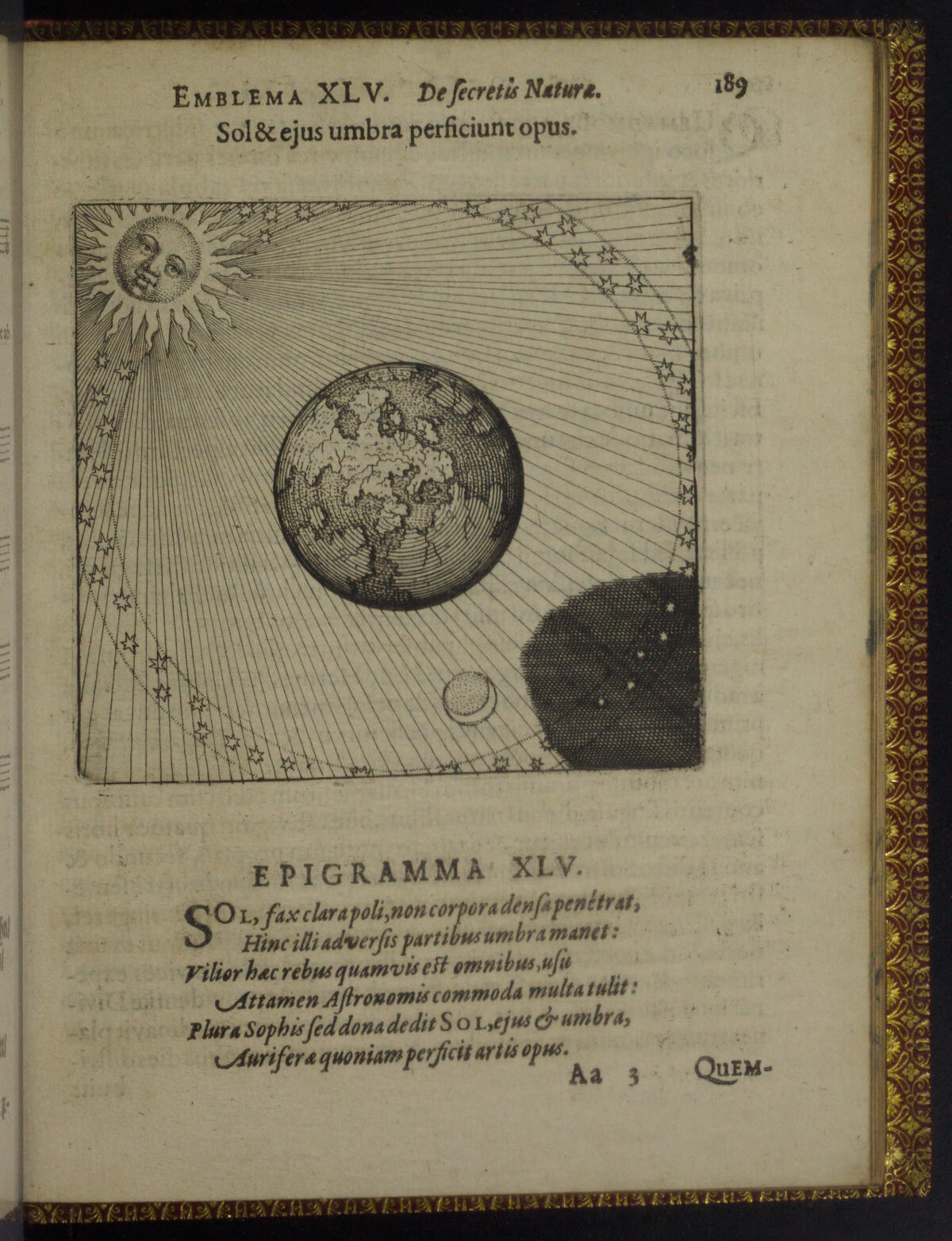
Atalanta fugiens (Michael Maier, 1617). Maier tells you in which register to read his fifty emblems: "This same virgin is purely chemical; she is the philosophical mercury fixed and held in its flight by the sulphur of gold" (our translation of «Esta misma virgen es puramente química; ella es el mercurio filosófico fijado y retenido en su fuga por el azufre del oro» «Maier — Atalanta fugiens (1617), trad. castellano · p. 10»). The mythology is the veil; the chemistry is the thing. And Nature is the guide: "Let Nature be your guide, let your art follow her step by step; away from her you lose yourself" (our translation of «Que la naturaleza sea tu guía, que tu arte la siga paso a paso; lejos de ella te pierdes» «Maier — Atalanta fugiens (1617), trad. castellano · p. 177»).
Jacob Boehme (Görlitz, 1612). Boehme says where he writes from: "Do not take me for an alchymist, for I write only in the knowledge of the spirit, and not from experience" «Jacob Boehme — Aurora, The Day-Spring (trad. John Sparrow; ed. Dekton Publishing, 2022) · p. 339». He judges the end of the metallic work: when it is almost made, "the spirit cannot elevate itself with its body into the light, but must remain to be a dead stone" «Jacob Boehme — Aurora, The Day-Spring (trad. John Sparrow; ed. Dekton Publishing, 2022) · p. 338». And he speaks "not of and from myself, but from that which the Spirit showeth, which no man can resist" «Jacob Boehme — Aurora, The Day-Spring (trad. John Sparrow; ed. Dekton Publishing, 2022) · p. 413».
The Golden Tract (in the Hermetic Museum, 1678). The anonymous German reasons from the end of the work: "Now to find the seed you should diligently consider for what purpose you require the Store" «The Hermetic Museum, tr. Waite (1893) · p. 34», where the old print reads Store for Stone. He says what the stone is: "This Stone, I dare to tell thee, is the powerful essence of the metal, and thou must be careful how thou dost obtain it" «The Hermetic Museum, tr. Waite (1893) · p. 43». He splits his own knowledge in two: "I do not speak of the matter—that was made known to me by the revelation of God alone; but I have by study discovered the secret of its solution, which is the same with ancient and modern Sages" «The Hermetic Museum, tr. Waite (1893) · p. 44». The sages are known by their agreement «The Hermetic Museum, tr. Waite (1893) · p. 17», and Nature comes first: "Foolish I call those who, without any previous knowledge of Nature and her properties, undertake to learn this Art" «The Hermetic Museum, tr. Waite (1893) · p. 19».
The Rosicrucian Secrets (attributed to John Dee, seventeenth century). The treatise says what the gift is and what it does: in the potable gold "is completed the precious gift of God, which is the Arcanum of all sciences in the world" «The Rosicrucian Secrets (atribuido a Dee) · p. 64», a gift that gives riches, metals and health, and nothing inner is on that list. The key of power came "by secret revelation from the Almighty God" «The Rosicrucian Secrets (atribuido a Dee) · p. 40». And on Nature and art: "nature hath created a matter unto art, unto which art neither addeth anything nor taketh anything away, but removeth such things as are superfluous" «The Rosicrucian Secrets (atribuido a Dee) · p. 22».
Thomas Vaughan (Wales, 1650s, as Eugenius Philalethes). Vaughan declares the end of the art: "Let me tell you then that the period and perfection of magic is no way physical, for this Art Attains the throne of Jove and things divine essays" «Vaughan — The Works of Thomas Vaughan, ed. Waite (1919) · p. 168». The common metals "are no way pertinent to our purpose" «Vaughan — The Works of Thomas Vaughan, ed. Waite (1919) · p. 363». He does say, on the same page, that there is "a twofold fermentation a spiritual and a bodily one" «Vaughan — The Works of Thomas Vaughan, ed. Waite (1919) · p. 363»; he stays on the side of the soul because he ranks the two. The thing was discovered by God Himself "to the first man" «Vaughan — The Works of Thomas Vaughan, ed. Waite (1919) · p. 168».
George Starkey, laboratory notebooks (New England and London, 1650s). The one voice on this map that never says where it looks at the work from. The notebooks record operations, results and failures; the closest thing to a declaration is a definition of the matter, and matter places no one. On where the knowledge comes from, Starkey is unreserved: "God communicated to me the whole secret of volatilizing alkalies" «Starkey — Alchemical Laboratory Notebooks and Correspondence (2004), ed. inglés, con los originales latinos enfrentados 2004 · p. 81». The sages "left the record of their <25r> search in writing, withall so veyling the maine secret that only an immediate hand of god must direct an Artist" «Starkey — Alchemical Laboratory Notebooks and Correspondence (2004), ed. inglés, con los originales latinos enfrentados 2004 · p. 276».
Eirenaeus Philalethes (George Starkey's masked corpus, according to William Newman). Under the mask, the same man says what the work is: "for our work is to make a substance fluid, penetrating and entring, that may have ingress into imperfect Metals" «Newman — Gehennical Fire (1994) · p. 71». Nature instructs inside the allegory: "we joyn kind with kind in our work, for Nature is mended and retained with its own Nature" «Newman — Gehennical Fire (1994) · p. 71». And the secret is "the Gift of GOD, [given] to whom, and when he pleaseth" «Newman — Gehennical Fire (1994) · p. 42».
Robert Boyle (London, 1660s, according to Lawrence Principe). Boyle says what makes the stone worth having, and the ranking is material: if it "were not an Incomparable Medicine, but were onely capable of transmuting other Metalls into G o l d" its discovery would not "much advantage M a n k i n d" «Principe — The Aspiring Adept (1998) · p. 200», with the spacing of the scanned print. The stone is, in his words, "purelly corporeall" «Principe — The Aspiring Adept (1998) · p. 213». He hoped that conversation with "true Adepti" might instruct him "concerning the Nature and Generation of M e t a l s" «Principe — The Aspiring Adept (1998) · p. 199».
Isaac Newton (Cambridge, 1670s to 1690s, according to William Newman). Newton "did not read alchemical authors as a means of acquiring spiritual truths; rather, he extracted experimental meaning from them even when they employed the idiom of divinity" «Newman — Newton the Alchemist (2019) · p. 75». He "held an exalted view of the supposed masters of the aurific art, the adepts" «Newman — Newton the Alchemist (2019) · p. 49», who had received the stone as "a divine dispensation, a donum dei" «Newman — Newton the Alchemist (2019) · p. 49». And the meaning of the chrysopoetic chymists "was inaccessible without a deep understanding of nature" «Newman — Newton the Alchemist (2019) · p. 183».
The Breviary attributed to Nicolas Flamel (printed 1758). The Breviary defines the art: "The science of converting metallic bodies into the perfection of gold and silver" (our translation of «La ciencia de convertir cuerpos metálicos en la perfección del oro y de la plata» «El Breviario (atribuido a Flamel) · p. 8»), and names the key: "The putrefaction of gold is the key to the whole mastery" (our translation of «La putrefacción del oro es la llave de toda la maestría» «El Breviario (atribuido a Flamel) · p. 33»). It is impossible to work "if God does not reveal the said secret or the master does not transmit it" (our translation of «si Dios no revela el referido secreto o el maestro no lo transmite» «El Breviario (atribuido a Flamel) · p. 20»); the writings of the Philosophers "must be understood according to Nature" (our translation of «deben ser entendidos según la Naturaleza» «El Breviario (atribuido a Flamel) · p. 5»); and the art "is obtained by the ingenuity of Nature, by the secret of the regimen of fire and by the skill of the operator" (our translation of «se consigue por el ingenio de la Naturaleza, por el secreto del régimen de fuego y por la habilidad del operador» «El Breviario (atribuido a Flamel) · p. 8»).
Mary Anne Atwood (England, 1850). "Man is the true laboratory of the Hermetic Art; his life the subject, the grand distillatory, the thing distilling and the thing distilled" «Principe — The Secrets of Alchemy (2013) · p. 113». Those who busied themselves with laboratory operations were, according to Atwood, "mere “literal souls” who failed to perceive the hidden truth of alchemy, and were not “real” alchemists at all" «Hanegraaff (ed.) — Dictionary of Gnosis & Western Esotericism, ed. inglés · p. 45». The knowledge she believed "to be a secret tradition dating back at least to the ancient Greeks" «Hanegraaff (ed.) — Dictionary of Gnosis & Western Esotericism, ed. inglés · p. 45».
Carl Gustav Jung (Zurich, 1944). Jung says what the chemistry was for: the alchemist "used it to devise a nomenclature for the psychic transformations that really fascinated him" «Jung — Psychology and Alchemy (1944) · p. 305». "He experienced his projection as a property of matter; but what he was in reality experiencing was his own unconscious" «Jung — Psychology and Alchemy (1944) · p. 262». And he puts the root of the art somewhere none of the old voices did: "the real root of alchemy is to be sought less in philosophical doctrines than in the projections experienced by individual investigators" «Jung — Psychology and Alchemy (1944) · p. 262».
Spiritus Mundi, our reading (El Umbral de la Consciencia, 2026, in progress). We enter the map as a voice, with our passages, and no privilege in the drawing. "From its origins, alchemy was a practical and experimental discipline, but never purely material" (our translation of «Desde sus orígenes, la alquimia fue una disciplina práctica y experimental, pero nunca puramente material» «El Umbral de la Consciencia (2026, en curso) · p. 365»); the work on matter and the work on the alchemist "were not two distinct processes, but two expressions of one movement of transformation" (our translation of «no eran dos procesos distintos, sino dos expresiones de un mismo movimiento de transformación» «El Umbral de la Consciencia (2026, en curso) · p. 365»). We hold that the art was received, "principles about the relation between matter, consciousness and transformation that experience confirms but does not originate" (our translation of «principios sobre la relación entre materia, consciencia y transformación que la experiencia» «El Umbral de la Consciencia (2026, en curso) · p. 364» «confirma pero no origina» «El Umbral de la Consciencia (2026, en curso) · p. 365»); that it survived "transmitted from operator to operator, from master to disciple" (our translation of «transmitida de operador a operador, de maestro a discípulo» «El Umbral de la Consciencia (2026, en curso) · p. 365»); and that "the understanding of nature preceded the operation" (our translation of «la comprensión de la naturaleza precedía a la operación» «El Umbral de la Consciencia (2026, en curso) · p. 367»).
What the map shows
The first finding is how few voices speak from both sides on purpose. Fourteen of the twenty-four look at the work from matter, six from the soul, three from both, and one never says. Zosimos, the oldest, is one of the three, and the scholarship agrees on why: for him the art "can only work if two conditions are met" «Hanegraaff (ed.) — Dictionary of Gnosis & Western Esotericism · p. 609», one in the furnace and one in the operator. Khunrath says the same thing thirteen centuries later with two rooms, the oratory and the laboratory. We are the third, and we say so.
The second finding is that "from matter" is not the same as the puffers' story. Every one of the fourteen also says where the art comes from, and the answers are not chemistry: a gift of God, a chain of sages, the light of Nature. Eighteen voices declare revelation, twelve the lineage, twelve Nature, and most declare more than one. The gift and the chain go together: the adepts "had received the philosophers’ stone as a divine dispensation, a donum dei" «Newman — Newton the Alchemist (2019) · p. 49», and Starkey writes that the sages left their record in writing and yet "only an immediate hand of god must direct an Artist" «Starkey — Alchemical Laboratory Notebooks and Correspondence (2004), ed. inglés, con los originales latinos enfrentados 2004 · p. 276».
The third finding is where the soul-only reading comes from. The medieval Aurora and the Rosicrucian Fama look from the soul, but neither denies the furnace; the Fama calls gold-making "a parergon" «Yates — The Rosicrucian Enlightenment (1972) · p. 328», a side work, and a side work is still a work. The two voices that make the furnace disappear are Atwood and Jung, from 1850 and 1944, and Jung is the only voice on the map that puts the root of the art in the investigator's own projections rather than in anything received.
The fourth finding is the silence. Starkey's notebooks, the most operative document on the map, never say what the work is. That is not a failure of the notebooks. It is what a practitioner's notebook looks like, and the map shows it as it is.
Now the gaps, stated. All twenty-four voices are Greek, Latin, German, French, English or Spanish, and the Chinese and Indian traditions of inner and outer alchemy are not on this map. Several voices speak through their historians, and the map says so in their names. And the same scholarship warns that "some modern writers have read various mystical or psychological meanings into Zosimos’s allegorical accounts, but in so doing they have largely ignored their context" «Principe — The Secrets of Alchemy (2013) · p. 29».
Questions you may ask
So was alchemy chemistry or religion?
The oldest voice refuses the choice, and so does the best scholarship on him: "it is incorrect to say that alchemy for Zosimos was itself a religion, and an exaggeration to say that his alchemy was Gnostic" «Principe — The Secrets of Alchemy (2013) · p. 32», yet "it is equally wrong to imagine that Zosimos could (or should) 'turn off' his ways of thinking" «Principe — The Secrets of Alchemy (2013) · p. 32» when at work on practical processes. Picture a craftsman who prays before lighting the furnace and takes notes while it burns. Asking which of the two he really was is our question, not his.
If it was about the soul, why all the furnaces?
Because the sources say the furnace was real. The Rosarium swears that the art is nothing more than dissolving and coagulating the stone «Rosarium Philosophorum, trad. castellano · p. 28». Starkey writes in his notebook what he can and cannot do with his gold «Starkey — Alchemical Laboratory Notebooks and Correspondence (2004), ed. inglés, con los originales latinos enfrentados 2004 · p. 92». Even the manifesto that mocks gold-making calls it a work. The soul reading was added on top of the furnaces, not instead of them.
Why does a recipe not tell you where its author stood?
Because a recipe is written from inside the work, and the work, in this tradition, is chemical and symbolic at once. An instruction to project one part of the tincture on a thousand of silver tells you what to do, not what the author thought he was doing. Only a sentence about the work does that, and this map keeps the two apart.
Where did the idea that alchemy was only about the soul come from?
From the nineteenth century. Mary Anne Atwood declared that "Man is the true laboratory of the Hermetic Art" «Principe — The Secrets of Alchemy (2013) · p. 113», and Jung later concluded that the alchemists' "experience had nothing to do with matter in itself" «Principe — The Secrets of Alchemy (2013) · p. 121». Both are real positions and both are on record. They are just fifteen centuries younger than Zosimos.
Where to read next
- The map itself, with every passage: spiritusmundi.com/en/ideas/la-obra-doble
- Where we stand: spiritusmundi.com/en/postura
- Zosimos of Panopolis: /en/actores/zosimo-de-panopolis, and the study behind the quotations: /en/obras/grimes-zosimus-tesis
- The Turba Philosophorum: /en/obras/turba-philosophorum
- The Splendor Solis: /en/obras/splendor-solis
- Atalanta fugiens, with its fifty emblems catalogued: /en/obras/atalanta-fugiens
- Aurora consurgens: /en/obras/aurora-consurgens
- Khunrath in context: /en/obras/khunrath-in-context-alchemist
- Thomas Vaughan, the works: /en/obras/the-works-of-thomas-vaughan-eugenius-philalethes
- George Starkey, the laboratory notebooks: /en/obras/starkey-alchemical-notebooks
- Newton the alchemist, by Newman: /en/obras/newman-newton-alchemist
- The Golden Tract and the Hermetic Museum: /en/obras/waite-hermetic-museum
- Jung, Psychology and Alchemy: /en/obras/jung-psicologia-y-alquimia
- The textbook stories and their sources: /en/obras/principe-secrets-of-alchemy
- El Umbral de la Consciencia: /en/obras/umbral-de-la-consciencia
- Next week's map: the philosophers' stone, fifteen voices on what the stone is and how one reaches it: /en/ideas/la-piedra-filosofal
Las imágenes
Facsímiles en dominio público o Creative Commons, con su crédito. Se sirven desde la institución que los custodia.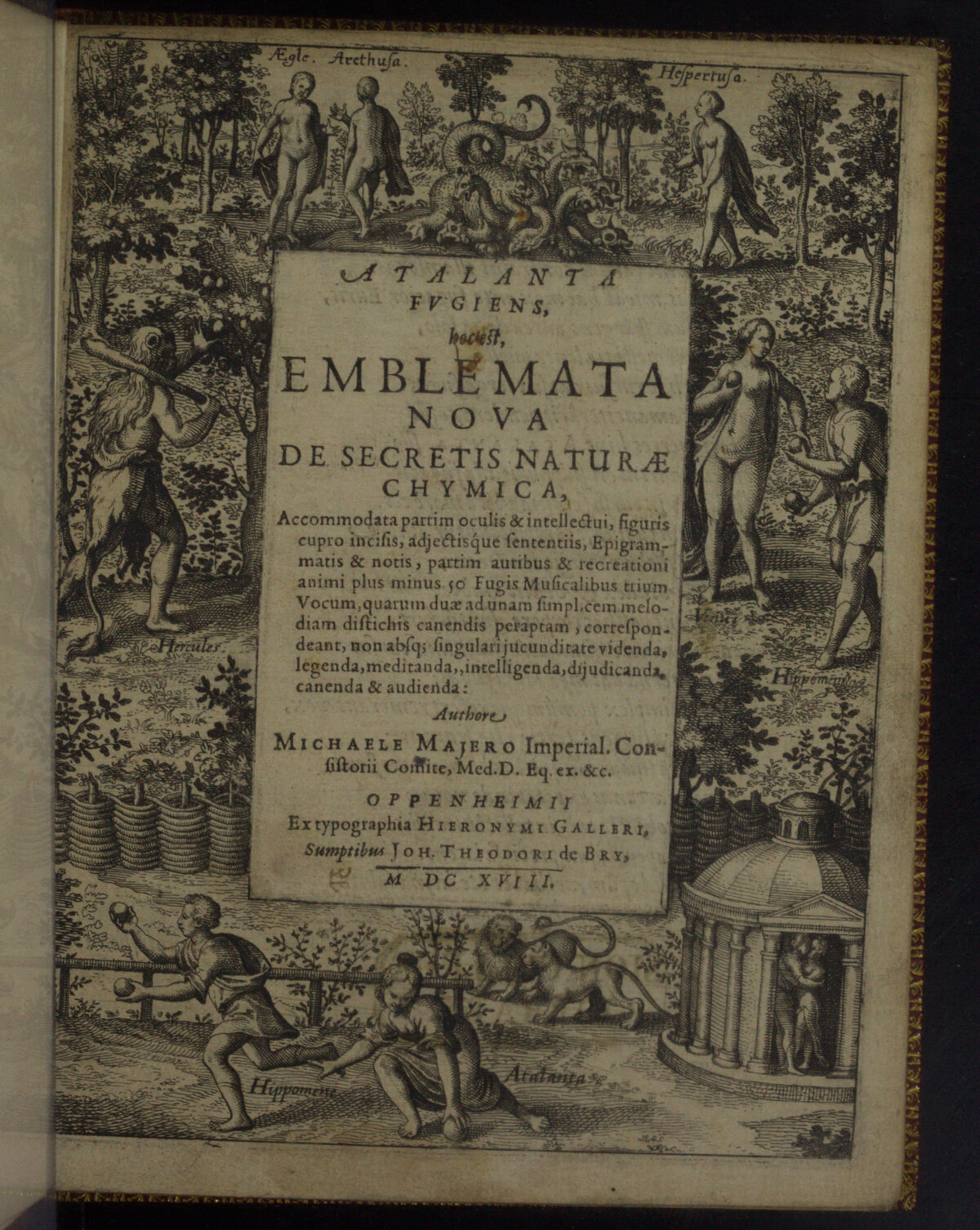


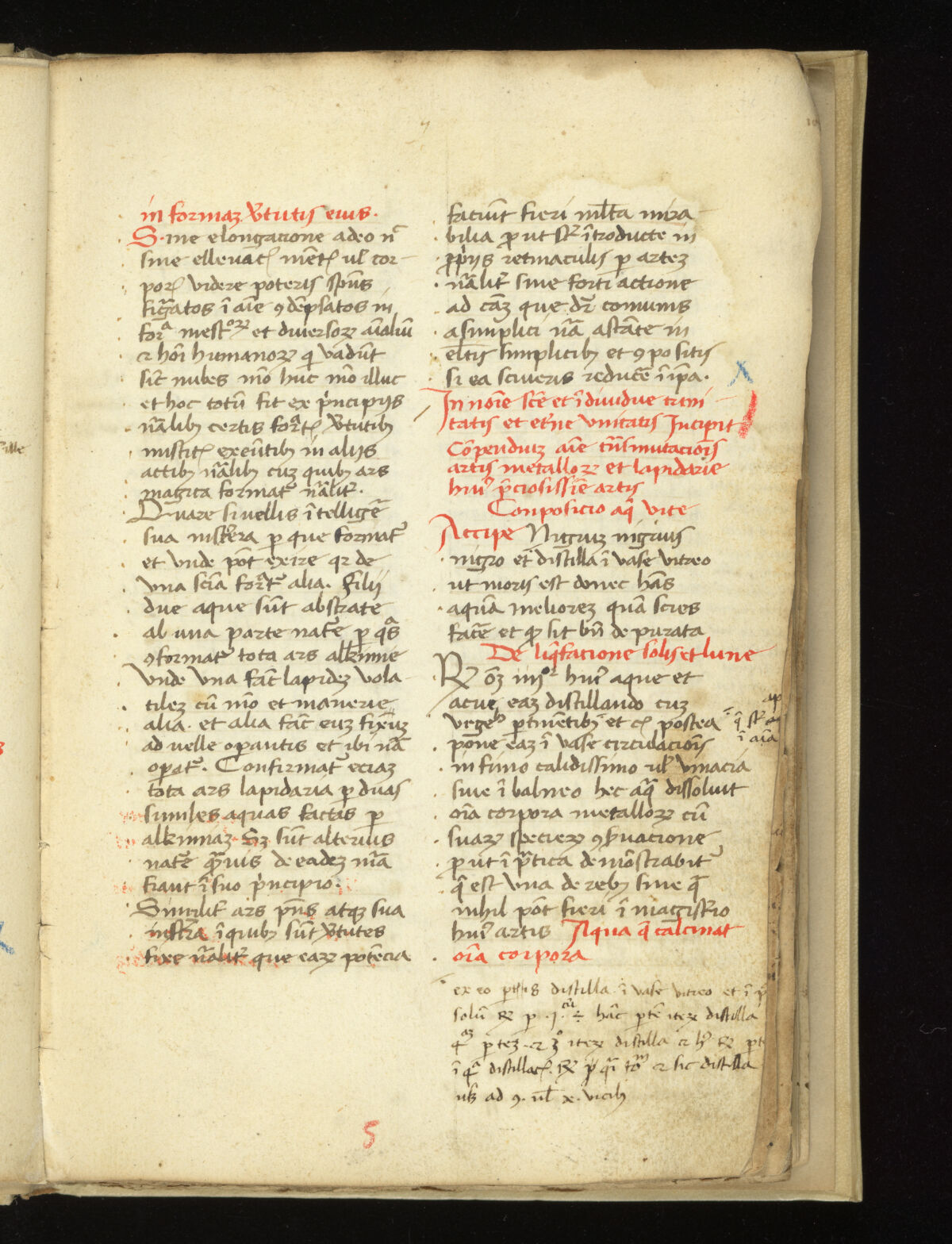
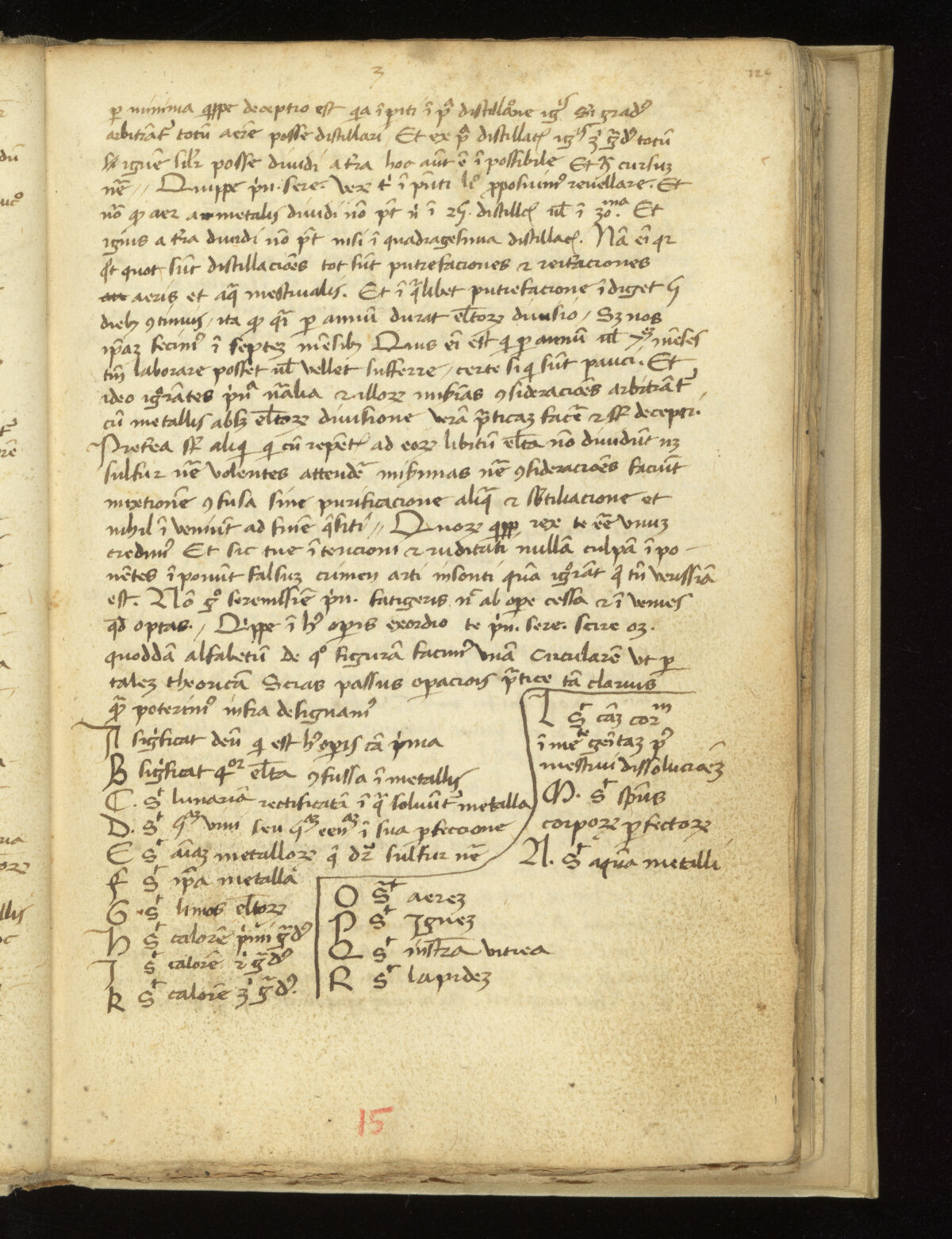


,_f.7_-_BL_Harley_MS_3469.jpg)

Las fuentes citadas
Cada cita del episodio existe en la ficha de su fuente con ese pasaje; lo verifica el exportador antes de publicar.- Starkey — Alchemical Laboratory Notebooks and Correspondence (2004), ed. inglés, con los originales latinos enfrentados 2004
- Maier — Atalanta fugiens (1617), trad. castellano
- Aurora consurgens, ed. latín e inglés 1966
- Jacob Boehme — Aurora, The Day-Spring (trad. John Sparrow; ed. Dekton Publishing, 2022)
- The Rosicrucian Secrets (atribuido a Dee)
- El Breviario (atribuido a Flamel)
- Grimes — Zosimus of Panopolis (tesis, 2006)
- Hanegraaff (ed.) — Dictionary of Gnosis & Western Esotericism
- Hanegraaff (ed.) — Dictionary of Gnosis & Western Esotericism, ed. inglés
- Jung — Psychology and Alchemy (1944)
- Karpenko, Purš y Žemla — Khunrath in Context (Brill, 2025)
- La Clavícula (pseudo-Llull), trad. castellano
- Newman — Gehennical Fire (1994)
- Newman — Newton the Alchemist (2019)
- Newman — Promethean Ambitions (2004)
- Paracelso — Obras completas, trad. castellano
- Principe — The Aspiring Adept (1998)
- Principe — The Secrets of Alchemy (2013)
- Rosarium Philosophorum, trad. castellano
- Splendor Solis, trad. inglés 1920
- Vaughan — The Works of Thomas Vaughan, ed. Waite (1919)
- Turba Philosophorum, trad. inglés 1896
- El Umbral de la Consciencia (2026, en curso)
- The Hermetic Museum, tr. Waite (1893)
- Yates — The Rosicrucian Enlightenment (1972)